
Garage Floor Resurfacing vs. Coating: Which Does Your Seattle Slab Actually Need?
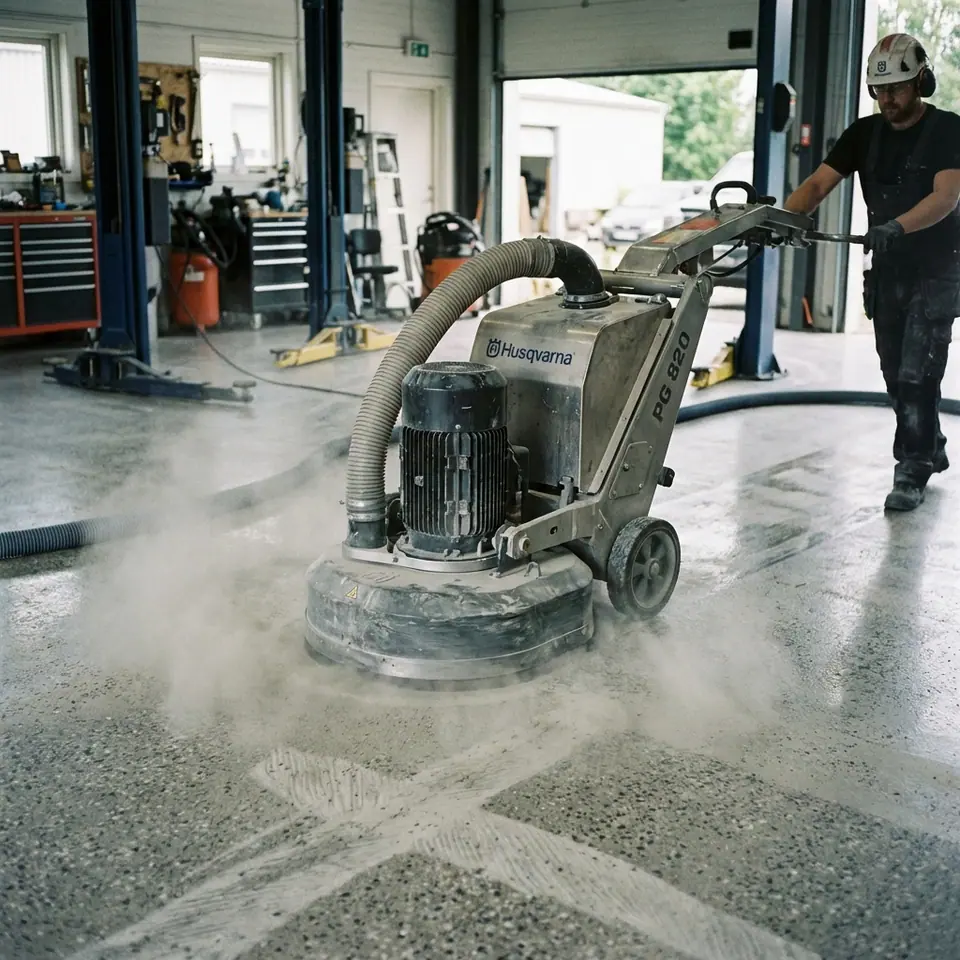
Short answer: Fix the layer that failed, and nothing more. If the concrete is solid and only the top is worn, stained or pitted, grinding it and coating it is the cheapest fix, and the only one that leaves you with a finished floor. If the damage runs deeper than a grinder should chase, a cement overlay rebuilds the surface, but it still needs a coating, and it has to dry before one goes on. Replace the slab only when the concrete itself is moving or breaking up.
Most people start by asking what resurfacing costs. Start with what failed instead, because that decides which fix you're shopping for. If you've already decided and want to see the work itself, our page on garage floor resurfacing and repair in Seattle walks through it. This guide is the step before: how to choose.
Ask three questions, in this order
Each answer can rule out a fix, so the order matters. You'll need a hammer, a long level or a straight board, a few quarters and a pencil.
- Is the slab moving? Look for a crack with one side higher than the other, a panel that rocks, or a section that has sunk at the door. For a crack you're not sure about, pencil a short line across each end and write the date beside it. If the crack has grown past your marks a few months later, the slab is still moving. Moving concrete needs a concrete contractor before anything goes on top, because no surface fix can hold it together.
- How deep is the damage? Four quarters stacked up are about a quarter inch tall. Hold the stack next to the deepest pits and flaking. Damage shallower than that, in patches, gets filled and ground flush as part of a normal grind and coat. Damage deeper than that across whole sections of the floor is where an overlay starts to make sense. For a dip, lay the level across it and slide quarters under the middle. Seven quarters is about half an inch.
- Is water coming up through it? White crust you can't sweep away, dark patches on a dry day, or fog under a square of plastic taped down overnight all point to moisture. It doesn't change the repair, but it changes the coating: a slab that moves water gets a moisture barrier primer under the coating, whichever fix you choose.
Last, tap the whole floor with the hammer, including the first few feet inside the door. A hollow sound means the top layer has come loose. A small hollow patch gets cut out and rebuilt; a large one pushes the job toward an overlay or a new slab.
What each symptom points to
| What you see | What it usually means | The fix it points to |
|---|---|---|
| Gray dust that's back a day after you sweep | A weak, powdery top skin | Grind it off, then coat |
| Oil stains, tire marks, faded patches | A dirty surface on sound concrete | Grind and coat |
| A web of fine cracks in the surface | Shrinkage in the top layer, usually cosmetic | Grind and coat |
| Small cone-shaped holes, or flaking just inside the door | Pop-outs, or wear from water and road salt | Grind back to sound concrete, patch, coat |
| Flaking or pits across whole sections, a quarter inch deep or more | A surface too far gone to grind out | Overlay, let it cure and dry, then coat |
| A low spot that holds a puddle | A dip in the pour or a settled patch | Up to about half an inch, a self-leveling overlay; deeper, a concrete contractor |
| A crack with a lip, a panel that rocks or has sunk | The slab is moving | Concrete contractor first, coating after |
| White crust, damp patches | Moisture coming up through the slab | Moisture test, and a barrier primer under any coating |
| An old coating peeling off | A failed bond, not a failed slab | Grind it off, then judge the concrete under it |
Most worn garage floors land in the first four rows. The peeling-coating row is its own decision, covered in recoating or redoing an old epoxy floor, and cracks get their own guide: can you coat a cracked garage floor.
What each fix leaves you with
Price is half the comparison. The other half is the floor you have when the work is done.
- Grind and coat keeps your slab, its slope to the door and its joints. What changes is the top: the weak layer is ground off, pits and cracks are filled, and a coating seals the concrete against oil, salt and water. You walk on it the next day and park after 72 hours. Dips and humps stay, because a coating takes the shape of the slab under it.
- A cement overlay gives you a new, even layer of cement, from a feather edge up to about half an inch. It's still bare, porous cement, so it dusts and stains like the old floor unless it's coated. The old slab's joints have to be carried through it, and the overlay maker's own data sheet warns that old cracks can come back if the slab moves. It also raises the floor a little, which can matter at the door seal and the step into the house.
- A new slab gives you new concrete, new joints and a chance to fix the slope or put plastic underneath. It's still bare concrete, though. For a finished floor, the coating comes later, after the slab has cured for about 28 days and passed a moisture test.
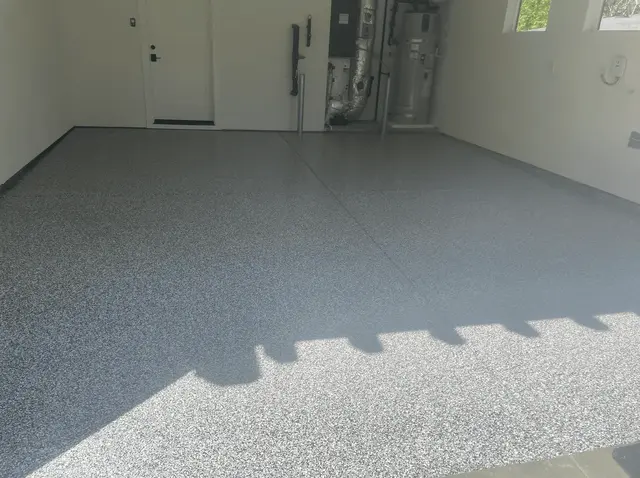
What a coating over a cement overlay needs
If your floor needs an overlay, the coating on top is where most of the risk sits. Four things decide whether it holds.
- The wait. The popular bagged resurfacers print walk and drive times, not a time to coat. People who call the maker report being told about 28 days before an epoxy. Pro-grade toppings print shorter waits: a day for a thin water-based sealer, up to a week for any coating over 20 mils, measured at 70°F and longer in a cold or damp room. A full flake floor is 30 to 40 mils, and a Seattle garage in winter is neither warm nor dry. Plan on about a month, and let a moisture test have the last word.
- The water. Bagged resurfacer instructions call for pressure washing the old slab, soaking it before the overlay goes on, and keeping the new layer damp while it cures. All of that water has to leave before a coating goes over it. The overlay won't hold back ground moisture later, either. It isn't a vapor barrier.
- The temperature. Both kinds of overlay want the slab and the air at 50°F or warmer while they go on and cure. An unheated Seattle garage often isn't, from fall to spring. The coating isn't the hold-up there; the overlay is.
- Bare concrete, and nothing on top. An overlay can't go over paint, sealer or an old coating, so those get ground off first. And some overlay crews finish with a sealer. If a coating is coming, ask them to leave the surface bare, or it has to be ground off again.
Once it has dried and passed the test, the overlay gets a light grind like any slab, the joints get filled, and the coating goes on. Our new concrete guide explains why cured and dry aren't the same thing.

What each fix costs per year of floor
Sticker prices mislead here, because the three fixes last different lengths of time and leave you with different floors. Divide each price by the years it buys. Figures are for a two-car garage, 400 to 500 square feet.
- Grind and coat: about $1,600 to $5,800, for 15 to 20 years or more. That's roughly $80 to $390 a year, for a finished floor.
- Overlay alone: about $1,500 to $3,500, for 8 to 15 years. That's $100 to $440 a year, for bare cement that still needs a coating.
- Overlay, then a coating: both bills, plus a month of waiting, and the coating is only as good as the overlay under it.
- New slab: about $4,800 to $9,000, for 30 years or more. Per year that can look cheap, but most of it pays for structure. If your slab is sound, you already own that part.
Taking an old coating off first adds about $1 to $3 a square foot to any of them. Coating prices by garage size are in our Seattle cost guide.
How to read a quote for each fix
A grind-and-coat quote
It should name the prep (diamond grinding, not an acid wash), say how cracks and joints get repaired, and say what happens if the moisture test comes back high. It should list every layer, say how much flake, give the cure times, and use the word adhesion in the warranty. The rest of the list is in questions to ask a garage floor contractor.
An overlay quote
- The product's name and how thick it goes on.
- How the old surface gets prepared, and whether taking off paint, sealer or an old coating is included.
- What happens to cracks and joints, in writing, including that old cracks can come back if the slab moves.
- How they'll keep the slab at 50°F or warmer in a cold garage.
- No sealer on top if a coating follows, and how long before the coating can go on.
- What they'll do if it comes loose.
A new-slab quote
- Tear-out and haul-away as their own line.
- How thick the slab is and what's under it. Four inches of concrete over packed gravel is the usual for cars; a car lift may need more under its posts.
- Plastic sheeting under the slab, asked for by name. Washington's code doesn't require it under a garage.
- Where the control joints go, and how many inches the floor drops toward the door.
- How they'll cure it. If you plan to coat, ask them to skip any cure-and-seal product.
- Who gets the permit, if one is needed, and when you can drive on it. About a week is typical. A coating has to wait about 28 days, then pass a moisture test.
When to wait instead
- A crack you're not sure about: mark it and watch it for a season before paying for any fix.
- A slab that only tests wet in winter: test again after a dry summer, or plan on the barrier primer.
- Plans that cut into the floor: a floor drain, a car lift or new plumbing goes in before any coating, not after.
Our crew grinds, repairs and coats. Leveling, lifting and replacing slabs is a concrete contractor's work. If your slab needs one first, you'll hear it at the estimate, before anyone spends money on a coating.
Resurface, coat or replace: questions
Is an overlay worth it if the floor is getting a coating anyway?
Only when the damage is too deep or too widespread to patch. Pits and flaking in spots get filled and ground flush during a normal grind and coat, so an overlay there would add cost, a month of waiting and a second layer that can come loose. Pay for one when whole sections are a quarter inch deep or more, or a dip needs filling.
Which costs less over time, a coating or a new slab?
On a sound slab, the coating. It fixes the only part that failed, the surface, and a new slab mostly buys structure you already own. Replacement makes sense when the concrete itself is moving or breaking up. Even then the new slab starts bare, so if you want a finished floor, plan for a coating about a month after the pour.
Is it better to resurface or replace a garage floor?
Resurface when the concrete is sound and only the surface has failed. Replace when the slab itself has: panels out of level, cracks with a lip that keep growing, or concrete that crumbles or sounds hollow across large areas. A surface fix laid over a moving slab breaks the same way the slab does, just later.
Can you epoxy over a resurfaced garage floor?
Yes, once the overlay has cured and dried. Bagged resurfacers don't print a time to coat, and about 28 days is the usual advice before epoxy. Pro-grade toppings list up to a week for thick coatings at 70°F, and longer in a cold, damp garage. Skip any sealer on the overlay, test it for moisture, and grind it lightly first.
How long does a resurfaced garage floor last?
A cement overlay on its own is usually rated for 8 to 15 years, if the slab under it stays still. A polyurea and polyaspartic floor over ground, moisture-tested concrete lasts 15 to 20 years or more. New concrete lasts 30 years or more. In each case, the prep under it decides more than the product does.
Can you coat a garage floor now and replace the slab later?
You can, but a coating only pays off on concrete that's staying. A polyurea and polyaspartic floor is a 15-to-20-year floor, and replacing the slab means breaking it up along with the old concrete. If the slab is moving, or a replacement is likely in the next few years, fix the slab first and coat the new one once it has cured.
Does Task Force Garage resurface garage floors?
We grind, repair and coat them, which is what most worn floors need. Every floor gets a diamond grind, crack and joint repair and a moisture test before the coating goes on. We don't level, lift or replace slabs. If yours needs that first, we'll tell you at the estimate, before anyone spends money on a coating.
Not sure what your floor needs?
We'll check the slab, tell you whether grinding and coating will fix it, and tell you straight if it needs a concrete contractor first.
Get A Quote