
Epoxy vs. Polyaspartic Garage Floor Coating: Which Actually Survives Seattle Rain?
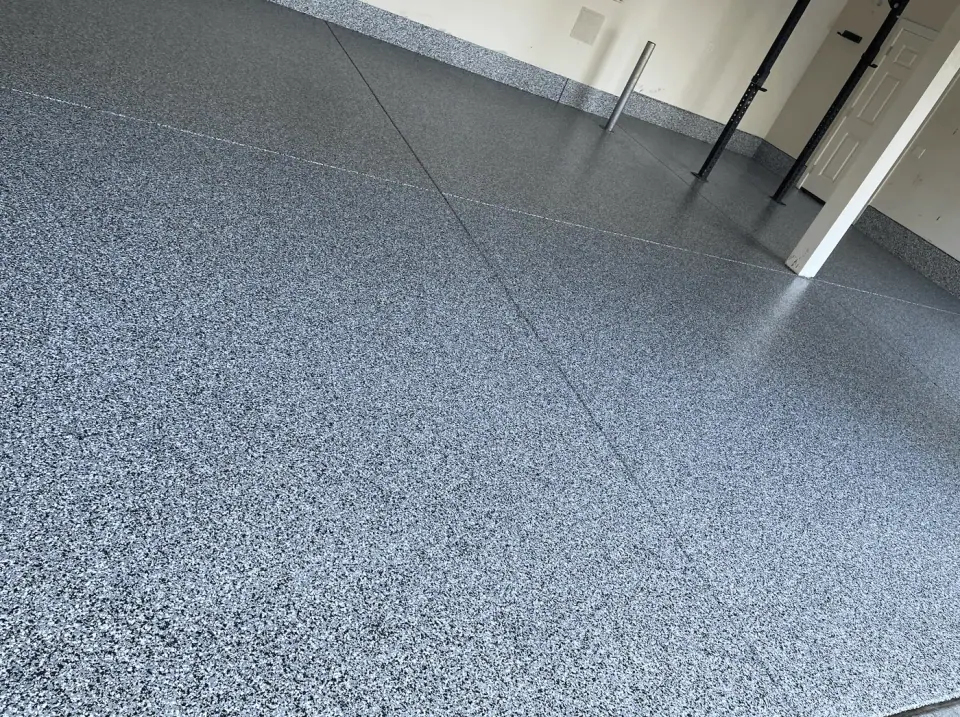
Short answer: In Seattle, polyaspartic beats epoxy on the three things that matter for a garage floor: how fast you can park on it, whether it yellows in the sun, and whether it bends with the concrete instead of cracking. Epoxy still wins on price and on the range of solid colors, which makes it a fair choice in a dry, warm climate. Seattle isn't that climate.
The straightforward differences
Both are two-part coatings that bond to concrete, but they're not the same stuff. Epoxy is a resin and hardener that cures into a hard, rigid shell. Polyaspartic is a kind of polyurea, the material in truck bed liners, that cures faster and stays a little flexible after it sets.
- Drying time. Epoxy needs a day or three before you can walk on it and up to a week before a car goes back in. Polyaspartic is ready to walk on the next day and park on after 72 hours. Without a moisture barrier the install is one day; with one, it's two, because the barrier primer cures overnight.
- Flex. Concrete swells and shrinks with the weather. Polyaspartic moves with it. Rigid epoxy is more likely to crack or let go under that stress over the years.
- Sun. Standard epoxy yellows and chalks in sunlight. A light-colored epoxy floor near a sunny garage door can visibly yellow within six to eighteen months. Polyaspartic doesn't.
- Smell. Polyaspartic is a low-odor formula and installs with far less smell.
- Price and looks. Epoxy is cheaper up front and comes in more solid colors, which is part of why it fills the hardware-store kits.
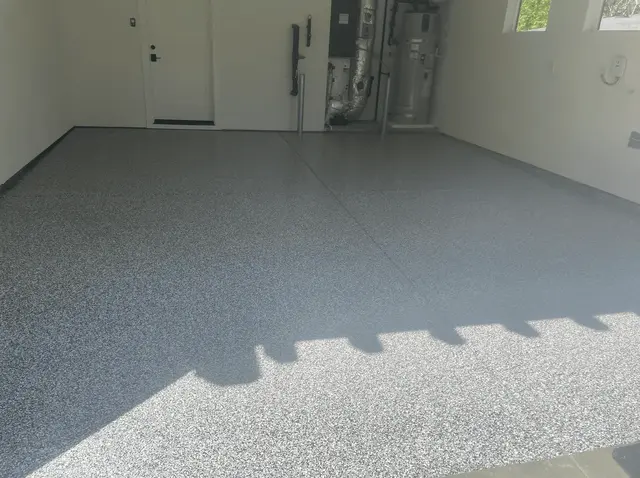
Is polyaspartic the same as epoxy?
No, even though the finished floors look alike and plenty of people call any coated garage floor "epoxy". Epoxy is an epoxy resin cured with a hardener. Polyaspartic is a kind of polyurea that cures faster, stays slightly flexible, doesn't yellow, and can go down in a cold garage. The one place the two overlap is the hybrid floor below: an epoxy base with a polyaspartic top coat. What polyaspartic is, layer by layer, is in what is polyaspartic floor coating.
Where polyurea fits
Polyaspartic isn't a separate material from polyurea. It's polyurea with an ingredient that slows it down. Plain spray polyurea sets in seconds and has to go on by machine. The polyaspartic version gives a crew time to roll it out by hand and control the finish.
The other split is about sunlight. Some coatings yellow in the sun and some don't. Polyaspartic top coats are the kind that don't, which is why they hold their color where epoxy turns amber.
That's why the two often work as a pair. Our floors use a polyurea base coat, which holds the flake, under a clear polyaspartic top coat that takes the wear. When a quote says "polyurea floor" or "polyaspartic floor", ask which layer it means, and what the base coat is made of.
Polyurethane is the other word that turns up on quotes. It's a cousin rather than a sibling. It cures more slowly than polyurea, and the sun-proof versions are used as thin clear coats over epoxy where speed doesn't matter. Polyaspartic goes on thicker and lets you park sooner. Polyurea on its own, and which layer it belongs in, has its own page: polyurea garage floor coating.
Two differences most comparisons skip
Stains. Epoxy is slightly porous, so oil, coolant and road salt can work into the surface over time instead of sitting on top. Polyaspartic's tighter finish resists that. That matters more in a garage that sees winter salt and wet tires than in a climate-controlled showroom.
Wear. In standard wear testing, polyaspartic outperforms epoxy. In a typical home garage you'd barely notice day to day. In a busy home workshop with heavy gear and constant foot traffic, it shows in how the floor looks after a few years.
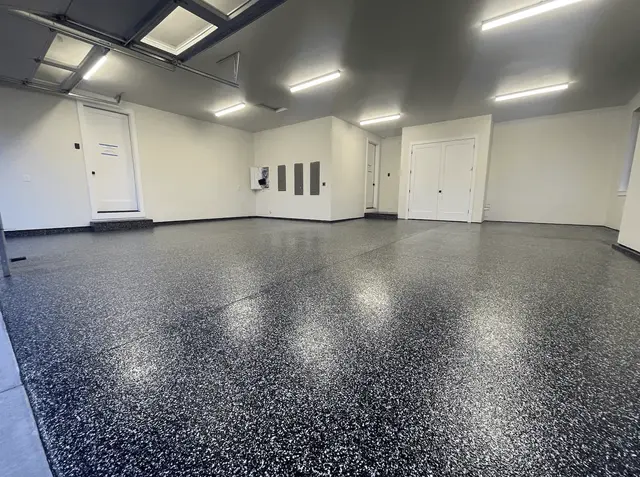
What about hybrid systems?
Some installers do both: an epoxy base coat for cost and color range, with a polyaspartic layer on top for sun, faster drying and better wear. It's a reasonable middle ground where epoxy's weak spots matter less. In Seattle, where moisture and the narrow curing window are the real problems, a full polyurea-and-polyaspartic floor removes more of the risk than a hybrid does.
What is better than epoxy for a garage floor? The alternatives, compared
Searches for "epoxy garage floor alternatives" usually mean one of five things:
- A polyaspartic flake floor. The direct upgrade: same look, faster drying, no yellowing, flexible, goes down in the cold. It's what we install.
- Polyurea. As a base coat under flake, it's part of the same floor. As a sprayed floor on its own, it's an industrial product, not a garage one.
- Interlocking tiles. Fast, no prep, and they come back up, which is also the weakness: water, salt and oil run under them and sit on bare concrete, and a tiled floor is loud and shifts underfoot.
- Roll-out mats. Cheapest, with the same problem as tiles and less protection. Fine as a parking pad over a coated floor, not as the floor.
- Garage floor paint or a sealer. One thin coat, no grinding, no flake. It wears through in the tire lanes within a season or two and hot tires lift it. It's what most "peeling epoxy" photos actually show.
Which one is right depends on whether you want a floor or a cover. Tiles and mats cover the slab. A coating becomes the slab's surface and protects it. In a Seattle garage, where the concrete is damp most of the year, the coating with the moisture test in front of it is the one that lasts. Every way to floor a garage, tiles and mats included, is ranked on garage flooring options for Seattle, and the coating types are compared in garage floor coating options.
Which should you actually choose?
If your garage is a low-traffic storage space that doesn't see big temperature swings, and you're fine with a shorter life in exchange for a lower price, standard epoxy is a fair choice. If it's a daily-use garage, with cars parked on it, Seattle's damp and winter runoff coming in on the tires, and you expect it to look good for over a decade, polyaspartic's drying speed, flex and sun resistance are doing real work, not just costing more for the sake of it.
Polyaspartic vs. epoxy cost
Per square foot, the installed ranges overlap more than most people expect: across the Seattle market, roughly $4 to $10 for epoxy and $4 to $12 for polyaspartic. What separates two quotes is mostly the prep, and how long the floor lasts before it has to be ground off and redone. Our Seattle cost guide puts numbers on both, per square foot and by garage size.
The cure-time difference is bigger in practice than it sounds
"A few extra days" undersells what epoxy's longer cure costs a household. With polyaspartic, the car is back in the garage in 72 hours. An epoxy floor can leave a car sitting in the driveway for three days to a week, depending on the product and the temperature, which matters more than it seems when you're the one working around it.
Why Seattle's climate tips this one way
Two of epoxy's real weaknesses are exactly what Seattle has plenty of: moisture that never quite leaves, and a narrow, humidity-sensitive curing window. Epoxy needs the slab somewhere between roughly 55 and 85 degrees to cure, and damp air slows it further. That's why most epoxy installs here get squeezed into July through September (see our timing guide). Polyaspartic's faster cure and wider tolerance sidestep that almost entirely, and its flex handles the constant small movements of a slab that's soaking up and giving off moisture through the seasons.
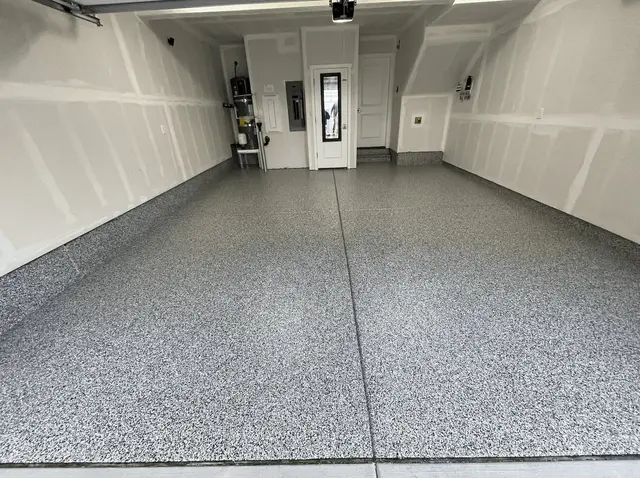
Outdoors, the choice is made for you
On a patio or pool deck, epoxy's weak spots stop being cosmetic. It yellows and chalks in direct sun, and a rigid coat on concrete that heats and cools all day is more likely to crack or let go. Outdoor concrete needs a top coat that stays clear and stays flexible, plus grit for traction when it's wet, which is how we build patio and pool deck coatings.
Where we land
It's why both of our main systems, Premium and Original, are full-flake polyaspartic floors rather than plain epoxy. Not a brand preference, a climate one. What's included in each is on our concrete coatings page.
Epoxy, polyaspartic and polyurea questions
Which lasts longer, epoxy or polyaspartic?
In a Seattle garage, polyaspartic, by a wide margin. A polyurea-polyaspartic floor over ground, moisture-tested concrete lasts 15 to 20 years or more. A pro epoxy floor lasts three to seven years here, and a DIY kit one to three. Damp from below and yellowing by the door end most epoxy floors before they wear out.
Does epoxy yellow over time?
Yes. Standard epoxy yellows and chalks in sunlight, and a light-colored floor near a sunny garage door can show it within six to eighteen months. Polyaspartic stays clear.
What's the difference between polyurea and polyaspartic?
Polyaspartic is a type of polyurea, slowed down so it can be rolled by hand and made to stay clear in the sun. Plain polyurea sets in seconds and is used as the base coat under the flake. Polyaspartic is the clear top coat over it.
Which is easier to repair, epoxy or polyaspartic?
Epoxy, if you want the patch to disappear. Its slower cure lets a repair be sanded and feathered into the floor around it. Polyaspartic cures fast and hard, so a patch can leave a faint edge, though fresh flake helps it blend. It needs fewer repairs, and if ours ever lets go of the concrete, our lifetime adhesion warranty covers the fix.
Does polyaspartic cost more than epoxy?
Per gallon, yes. Installed, the ranges overlap: roughly $4 to $10 per square foot for epoxy and $4 to $12 for polyaspartic in the Seattle market. Prep is what separates two quotes, and a polyaspartic floor that isn't redone every few years costs less over time.
Can you use epoxy on a patio or pool deck?
Not well. Epoxy yellows and chalks in direct sun and cracks as outdoor concrete heats and cools. Outdoor slabs need a top coat that stays clear and flexible, with grit for traction, which is a polyaspartic job.
Is polyaspartic the same as epoxy?
No. Epoxy is a resin and hardener that cures rigid and yellows in sunlight. Polyaspartic is a kind of polyurea that dries faster, stays slightly flexible, stays clear, and can go down in a cold garage. People call any coated garage floor "epoxy", which is why both names end up on one quote.
What are the alternatives to an epoxy garage floor?
A polyaspartic flake floor is the direct upgrade. Interlocking tiles and roll-out mats cover the slab instead of coating it, so water and salt get underneath. Garage floor paint and sealers are one thin coat that wears through in the tire lanes. For a Seattle garage, a coating with a moisture test in front of it is the one that lasts.
Want to see it on your own floor first?
Upload a photo of your garage to our AI floor preview and try the flake blends before you book the estimate.
Try the AI Floor Preview