
Polyurea Garage Floor Coating in Seattle: What It Is, Which Layer It Belongs In, and Polyurea vs Polyaspartic
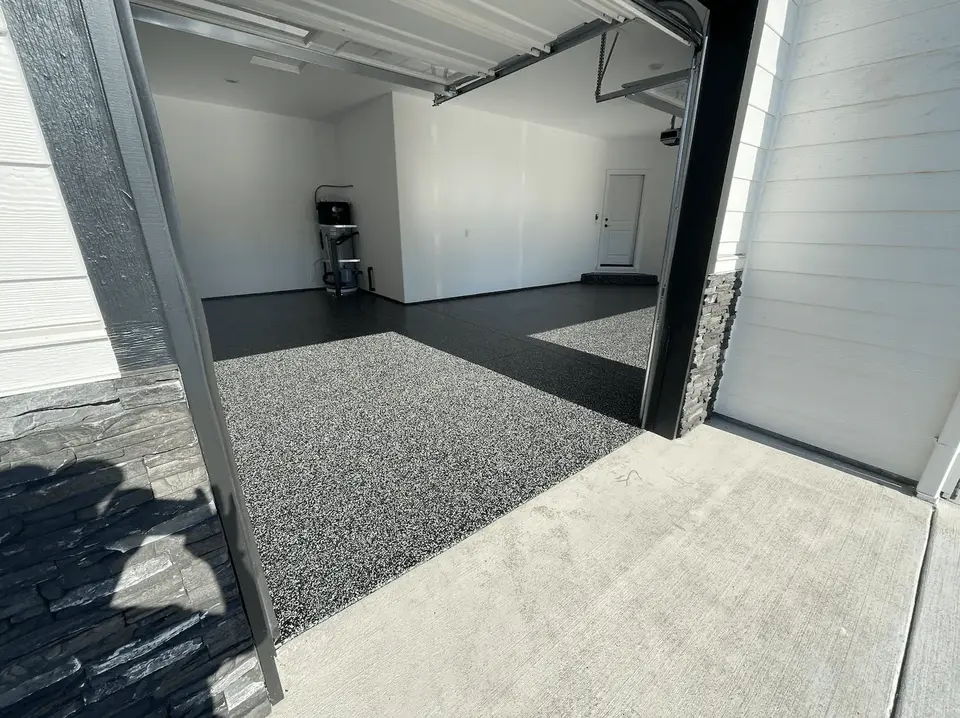
Short answer: Polyurea is the base coat under most good garage floors. It's the same tough, rubbery stuff as a spray-in truck bed liner. It grips ground concrete hard, bends instead of cracking, and holds the flake. Polyaspartic, which is a slowed-down kind of polyurea, goes on top as the clear coat because it doesn't yellow. So "polyurea vs polyaspartic" isn't a choice between two floors. A good floor uses both, in that order.
Quotes around Seattle throw both words around, sometimes as if they were rivals. Here's what polyurea is, where it belongs on your floor, how it stacks up against polyaspartic and epoxy, and what to ask when a quote says "polyurea".
What is a polyurea garage floor coating?
Polyurea is a two-part coating: an isocyanate, the A side of the kit, and an amine resin, the B side. The two react the moment they meet and set in seconds to a few minutes. When it sets it's tough and stretchy: it takes impact without chipping, it bends with the concrete through hot and cold, and it bonds hard to concrete that's been ground open. Because it sets so fast, the plain kind is usually sprayed by machine rather than rolled.
There are two kinds that matter for a garage, and data sheets name them. Aromatic polyurea is built on ring-shaped molecules that soak up ultraviolet light, so it yellows and goes chalky in the sun. It's strong, flexible and cheaper. Aliphatic polyurea is built on chain-shaped molecules that sunlight doesn't break down, so it holds its color, and it costs more. Polyaspartic is the aliphatic kind, slowed down so a person can roll it; our polyaspartic floor coating page has the details. That's why the two work as a team: aromatic polyurea underneath, buried under full flake where the sun never reaches it, and polyaspartic on top.
Two checks follow from that. A polyurea top coat should say aliphatic on its data sheet. And partial flake leaves the base coat showing between the chips, so an aromatic base can yellow there, starting at the door.
Which layer polyurea belongs in
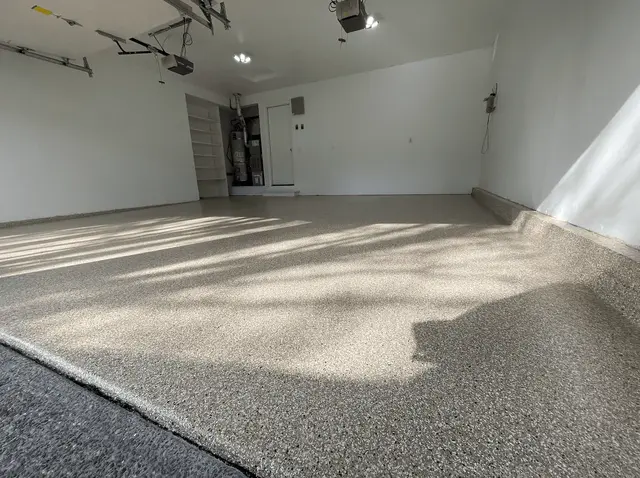
A flake floor is built in layers, and each one has a job:
- Your concrete, ground open with a diamond grinder, cracks repaired, and a moisture barrier primer first if the slab needs one.
- Polyurea base coat. Soaks into the open concrete, grips hard, bends with the slab, and holds the flake that's thrown into it while it's wet.
- Flake, thrown until the floor won't hold any more, then scraped flat.
- Clear polyaspartic top coat with anti-slip grit. The layer you see and drive on.
That's the floor we install on every Premium and Original job, and it's laid out layer by layer on our garage floor coating page. Put aromatic polyurea on top and the floor turns a warm yellow near the door within a couple of summers. Put polyaspartic alone on bare concrete and you give up some of the grip and flex the base coat brings.
Polyurea vs polyaspartic
- Set time. Polyurea: seconds to minutes, sprayed or rolled fast. Polyaspartic: about half an hour of working time, rolled by hand.
- Flex. Both bend with the slab. Polyurea bends a little more.
- Sun. Aromatic polyurea yellows. Polyaspartic stays clear.
- Cold, damp slab. Both handle it. Epoxy doesn't.
- Job. Polyurea: base coat, holds the flake. Polyaspartic: clear top coat, takes the wear.
- Cost. Polyurea costs less per gallon.
Installers argue about which one is "stronger". The honest answer is that it depends on the exact product more than on the name, and that neither one belongs alone on a floor that sees daylight and tires. Together, in the right order, they outlast epoxy by a lot. The long version is in epoxy vs polyaspartic vs polyurea.
Why fast cure takes a practiced crew
Pot life is how long a mixed batch stays usable. Sprayed polyurea gels in seconds, so its two sides are heated and mixed inside the spray gun at about 2,000 pounds per square inch. The polyurea in a floor base coat is slowed down so it can be rolled, and its makers give it roughly 10 to 30 minutes in the bucket. On the floor the window is shorter. Heat, humidity, sun through the door and big batches all speed it up.
So a fast floor is a team job. Batches are mixed small, spread, back-rolled and flaked while still wet, with a wet edge kept from wall to wall so no seam sets up. A coat that starts to set shows roller marks or lap lines, or won't hold the flake, and once it cures, the fix is grinding it off. That same speed is what makes a one-day garage floor coating possible.
Polyurea vs epoxy
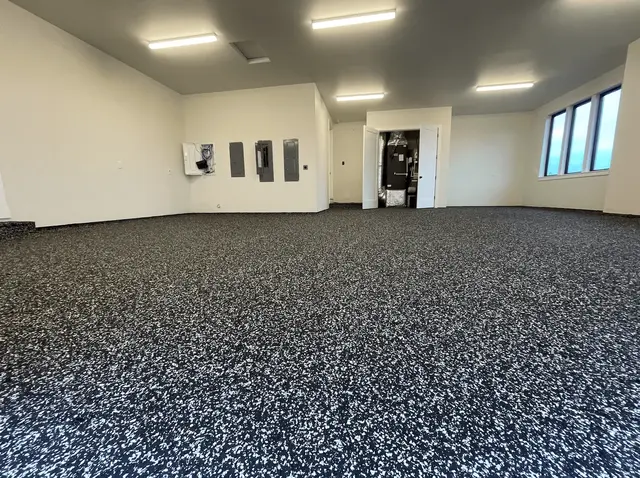
Epoxy cures hard and rigid. It needs a warm, dry slab, roughly 55 degrees and up. It yellows in the sun, and it keeps cars out for three days to a week. Polyurea stays flexible, cures in a cold garage, grips at least as hard, and on our floors takes a car after 72 hours under its polyaspartic top coat. Epoxy wins on price and on the range of solid colors, which is why it fills the hardware-store kits. In a Seattle garage, where the slab is cold and damp most of the year, the cure window and the flex decide it. If an epoxy floor has already let go on you, why epoxy garage floors peel explains what happened.
Why a flexible base coat matters on a slab that moves
Concrete grows and shrinks with temperature. Across a 20-foot garage, a 40-degree swing between winter and summer moves the slab about a twentieth of an inch, and almost all of that shows up at the joints and cracks, which open and close a hair.
Data sheets measure flexibility as elongation: how far a strip of the cured coating stretches before it tears. Standard floor epoxies stretch about 2 to 5 percent. Roll-on polyurea base coats stretch many times that, and sprayed polyurea runs to hundreds of percent. A rigid coat bonded across a joint has to take the movement in one hairline, so it cracks along the joint. A flexible base spreads it out. That's small, seasonal movement; a crack that's sinking or lifting gets fixed before any coating goes down.
Why polyurea works on a Seattle slab
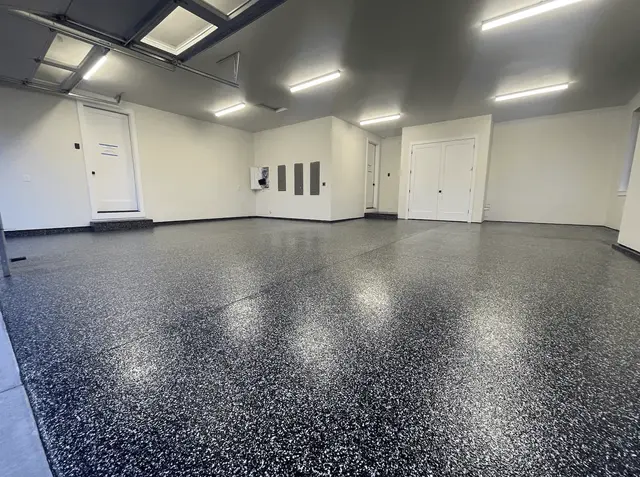
A Seattle garage gives a coating three problems. The slab is cold and wet from fall to spring. The concrete moves between a frosty night and a sunny afternoon. And moisture pushes up from wet ground underneath. Polyurea handles the first two on its own: it cures without waiting for summer, and it bends with the slab instead of shearing off it. The third one needs a moisture test and, when the slab calls for it, a barrier primer under the base coat. See do you need a moisture barrier.
Is a polyurea floor the same as a truck bed liner?
Same family, different recipe. A spray-in bed liner is usually aromatic polyurea, sprayed hot from a machine about a tenth of an inch thick, with a rough texture for grip. Left in the sun, a black liner fades toward gray unless it gets a separate clear coat. A garage floor flips most of that: a base coat rolled thin, a full layer of flake, and a smooth, clear aliphatic top coat. Our finished floor is about 30 to 40 mils thick, close to the thickness of a credit card. A liner's texture would trap grit, and its fading would show first at the door, so a floor borrows the toughness and leaves the rest.
What to ask when a quote says "polyurea"
- Which layer? Base, top, or both. A polyurea top coat has to be the aliphatic kind or it will yellow.
- Is it one coat? Some "polyurea floors" are a thin base with flake and no top coat. Ask for the full stack.
- Pure or hybrid? The polyurea trade group calls a coating pure only if its resin side is all amine. A hybrid swaps in some polyurethane resin, which is cheaper, slower and fussier about damp air while it cures. Some installers also say "hybrid" for an epoxy base under a polyaspartic top coat. Ask which they mean, and for each layer's data sheet.
- What's the moisture plan? A fast-setting coat over a damp slab seals the moisture in. Test first, barrier when needed.
- How much flake? Full coverage, or partial. Partial shows base coat between the chips and wears faster.
- What does the warranty cover, in writing? Ours is a lifetime adhesion warranty on every floor. What that means is in what a garage floor coating warranty actually covers.
Polyurea questions
What is polyurea floor coating used for?
As the base coat of a flake garage floor, where its grip and flex matter most, and in industrial jobs as a sprayed liner. On our floors a polyurea base holds the flake under a clear polyaspartic top coat.
Is polyurea better than polyaspartic?
They do different jobs. Polyurea bends more and sets faster, so it makes the better base coat. Polyaspartic stays clear in the sun and gives the crew time to roll it, so it makes the better top coat. A good floor uses both.
Does polyurea yellow in the sun?
The aromatic kind does, which is why it goes under the flake, where the sun never reaches it. The aliphatic kind, which includes polyaspartic, stays clear. The data sheet says which one you're getting.
Is polyurea better than epoxy for a garage floor?
For a Seattle garage, yes. It bends where epoxy is rigid, cures in a cold garage where epoxy needs a warm, dry slab, doesn't yellow, and under a polyaspartic top coat takes a car after three days, where epoxy can take up to a week.
How long does a polyurea garage floor last?
As part of a polyurea-base, polyaspartic-top floor over ground concrete with the moisture handled, 15 to 20 years and often longer. Every floor we install carries a lifetime adhesion warranty.
Can polyurea go over existing epoxy?
Only over epoxy that is firmly stuck down everywhere, and only after grinding it dull so the new coat can grip. Epoxy that is peeling anywhere comes off down to bare concrete first.
Is polyurea slippery?
The polyurea base coat is never the surface you walk on. The clear polyaspartic top coat is, and we mix anti-slip grit into it. The flake adds texture too.
Want the full stack on your own floor?
Book a free on-site estimate. We measure, test the slab for moisture, and put the system, the schedule and the warranty in writing.
Get A Quote