
Why Epoxy Garage Floors Peel in Seattle, and What to Do About It
Short answer: Peeling epoxy is almost never a bad product. It's a bad bond. And there are only five ways the bond goes wrong: the concrete was never properly prepped, moisture pushed the coating up from below, something was sitting between the epoxy and the slab, it was put down cold or damp, or someone drove on it too soon. Across the country, bad prep is the number one cause. In Seattle, moisture is right behind it, and on an older slab it's usually the real reason.
The good news is that a peeling floor tells you what happened, if you know how to read it. Here's how, and what fixing it actually takes.
How to read the failure before you call anyone
- It comes up in sheets, with a smooth back. The coating never bonded. Flip a piece over. If the underside is glossy with no concrete texture on it, the slab was never ground. That's a prep failure.
- Bubbles came first, then the peeling. Something pushed up from below. If the underside is damp, chalky or white, it's moisture. That's the Seattle failure.
- It only peels where the tires sit. Hot-tire pickup. A thin or half-cured coating went soft under a warm tire and lifted off. Very common with kits.
- It peels along the cracks and joints. The slab moved and a rigid coating couldn't move with it, or the cracks were painted over instead of filled.
- Round or patchy spots lifted early. Oil, tire shine, silicone spray, an old sealer, or the curing compound on newer concrete.
- It flaked where someone walked on day one. Used too soon, or mixed wrong.
Cause 1: the concrete was never properly prepped
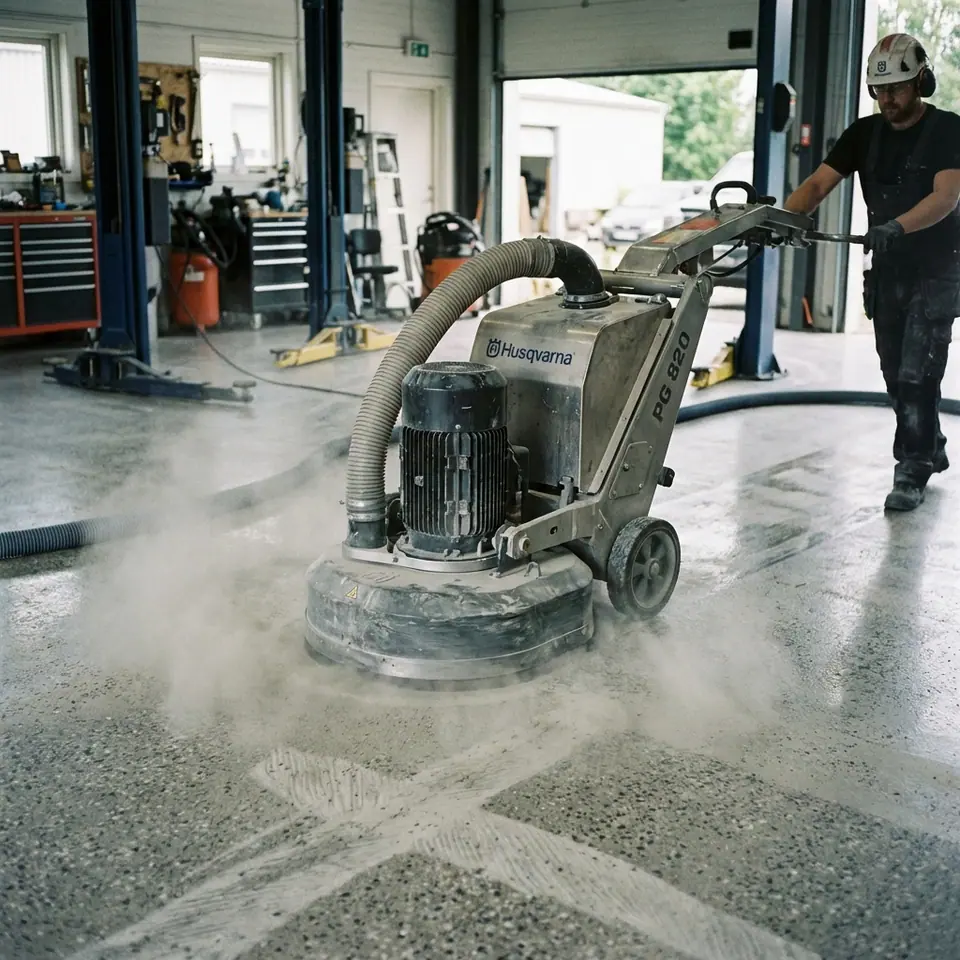
Epoxy doesn't stick to concrete the way paint sticks to a wall. The slab has to be opened up so the coating can grab hold. Most kits tell you to etch the floor with acid. That's the single most common reason a garage floor peels in sheets a year later. Acid leaves a weak surface, and if the residue isn't rinsed and vacuumed off completely, it leaves a layer of dust that the epoxy sticks to instead of the slab. A hard, dense garage slab barely reacts to acid at all.
Diamond grinding is the fix, and the standard. A grinder takes off the top skin of the concrete, opens it up, strips old sealers and paint, and leaves a surface the coating can bite into. It's the first thing our crew does on every floor, because nothing you put on afterward can make up for skipping it.
Cause 2: moisture pushing up from below
Concrete is a sponge. Water in the ground under your garage moves up through the slab as vapor, and around Seattle the ground is wet from October to April. A bare slab lets that vapor pass through. An epoxy floor doesn't. The vapor collects under the coating, pressure builds, and the coating bubbles and then peels, usually starting in the lowest corner. Older slabs are the worst for this, because many were poured with no plastic sheet underneath.
No coating chemistry fixes this. What fixes it is a moisture test before the job, and a moisture barrier primer on the bare slab when the test says the slab needs one. The barrier cures overnight before the base coat, which is why a floor that needs it is a two-day job. The test and what the numbers mean are in why garage floors fail in Seattle.
Cause 3: something between the epoxy and the slab
Oil that soaked in over the years and only got wiped off the top. Tire shine or silicone spray that drifted onto the floor. A clear sealer from a previous owner. On newer homes, the curing compound sprayed on a fresh slab, which is designed to stop anything from soaking in. And old paint, which peels and takes the new coating with it. All of these act like a release layer. All of them come off with grinding, not with cleaning.
Cause 4: put down cold, damp or in a hurry
Epoxy wants a warm, dry slab, at least 55 degrees or so, with low humidity. A Seattle garage offers that for a few months a year. Put down cold, epoxy cures slowly and never fully hardens, and it can grow a hazy film that the next coat won't stick to. Put down on a damp slab, it never bonds at all. Add the mixing mistakes that come with a bucket and a drill, and you've got most of the other peeling floors in town. Polyaspartic cures in the cold, which is one reason we install it instead. The full comparison is in epoxy vs. polyaspartic vs. polyurea.
Cause 5: driven on too soon
Epoxy usually needs three days to a week before a car goes back in, longer in a cold garage. Park on it too soon and a warm tire sinks into the soft coating, cools down, and pulls the coating up when the car leaves. That's hot-tire pickup. Thin kits are the worst for it, because there's nothing to soak up the heat. On our floors the rule is walk the next day and park after 72 hours, and hot-tire pickup is covered by the warranty.
Can you epoxy over a peeling epoxy floor?
No. Anything you put over a coating that's letting go fails with it, usually faster, because the new coat adds weight to a layer that's already lifting. A spot repair only works when the peeling is in one small area and everything around it is stuck down solid. Tap it and try to lift the edges with a putty knife. If it comes away, keep going until it doesn't. A floor that's peeling in more than a couple of places is a strip-and-redo. Even a sound epoxy floor has to be ground dull before a new coating will stick to it. How to tell whether an old floor can take a new coat, and what each path costs, is on our page about how to recoat or redo an old epoxy floor.
What a proper repair involves
- Grind everything off. Old coating, paint, sealers and the failed epoxy come off down to clean concrete. Taking off half leaves a seam that fails first.
- Repair the cracks and joints. Cracks get filled and ground flush. On a Premium floor, the bigger ones are cut open and rebuilt.
- Test for moisture. The reading decides whether the slab gets a barrier primer, which turns a one-day job into two.
- Recoat with a system that fits the slab. A flexible polyurea base coat, full flake, and a clear polyaspartic top coat with anti-slip grit. Cars back in after 72 hours.
The layer-by-layer build is on the garage floor coating page. The hour-by-hour schedule is in the install timeline.
Can you coat a cracked garage floor?
Yes, in almost every case. Hairline cracks get filled and ground flush. Wider ones get cut open, filled and rebuilt so the repair is as hard as the slab around it. What no coating can do is bridge a crack that's still moving. If one side sits higher than the other, or the gap grows every year, the slab has a settling problem that needs a concrete contractor first, and we'll tell you that at the estimate instead of coating over it. Crack by crack, with what the repair does to the price, is in can you coat a cracked garage floor.
How our crew keeps it from happening
Every one of the five causes has a step aimed at it: a diamond grind on every slab, crack repair before coating, a moisture test before we quote and a barrier primer when the slab needs it, a polyurea base that flexes with the concrete, a polyaspartic top coat that cures in a cold garage, and a cure schedule we put in writing. That's why we can put a lifetime adhesion warranty on the floor. If it peels, blisters or lifts under a hot tire, we fix it at no charge. What that covers, and the fine print to check on any quote, is in what a garage floor coating warranty actually covers.
Peeling and repair questions
Why is my epoxy garage floor peeling?
One of five reasons: the concrete wasn't ground before coating, moisture pushed the coating up from below, something like oil, sealer or curing compound was under it, it was put down in a cold or damp garage, or it was driven on before it cured. Sheets with a smooth back mean a prep failure. Bubbles first, then peeling, mean moisture.
What does white powder under peeling epoxy mean?
Usually moisture. Water vapor rising through the slab carries salts out of the concrete and leaves them as a white, gritty crust where the coating let go. On a floor that was acid-etched, a fine, even white dust can also be etch residue the epoxy stuck to instead of the concrete. Either way, the next floor needs a grind to clean concrete and a moisture test first.
How do you fix a peeling epoxy garage floor?
Grind the failed coating off down to clean concrete, repair the cracks, test the slab for moisture and put down a barrier primer if it needs one, then recoat. A spot repair only holds when the peeling is in one small area and everything around it is solid.
Why does epoxy peel along cracks and joints?
Because the slab moves there and epoxy doesn't. Concrete opens and closes a little at its cracks and joints as it warms, cools, wets and dries. A rigid coating rolled across them, instead of over cracks that were filled and ground flush, splits along the line and starts lifting at the edges. A crack that keeps growing is a slab problem to fix before any coating.
Why does epoxy peel where the tires sit?
Hot-tire pickup. A warm tire softens a thin or half-cured coating, the coating sticks to the rubber as it cools, and it lifts when the car moves. A thicker coating, a proper cure before parking and a polyaspartic top coat prevent it.
Does the warranty cover a floor that peels?
Yes. Our lifetime adhesion warranty covers the coating letting go of the concrete, including peeling, blistering and hot-tire pickup. We repair or recoat the area at no charge. It doesn't cover dings, scratches, stains or driving on the floor before the cure times we give you.
What does it mean if concrete comes up with the peeled epoxy?
The bond held, and the top of the slab didn't. A thin, weak skin of cement, dusty from the day it was finished or worn down by salt, pulled away with the coating. That weak layer is rarely in just one spot. The fix is grinding down to hard, sound concrete before anything new goes on, whatever coating you choose.
Floor already peeling?
Send us a photo of the worst spot or book a free on-site estimate. We'll tell you which of the five it is, and whether it's a repair or a redo.
Get A Quote